
The cybersecurity industry currently faces a global shortfall of roughly 4 million professionals. For you, this isn’t just a statistic—it’s a massive opening. Whether you are looking to pivot from a dead-end retail job or you’re a high school graduate wary of the four-year university debt trap, the question isn’t whether to enter cybersecurity, but how to do it the fastest without sacrificing your long-term earning power.
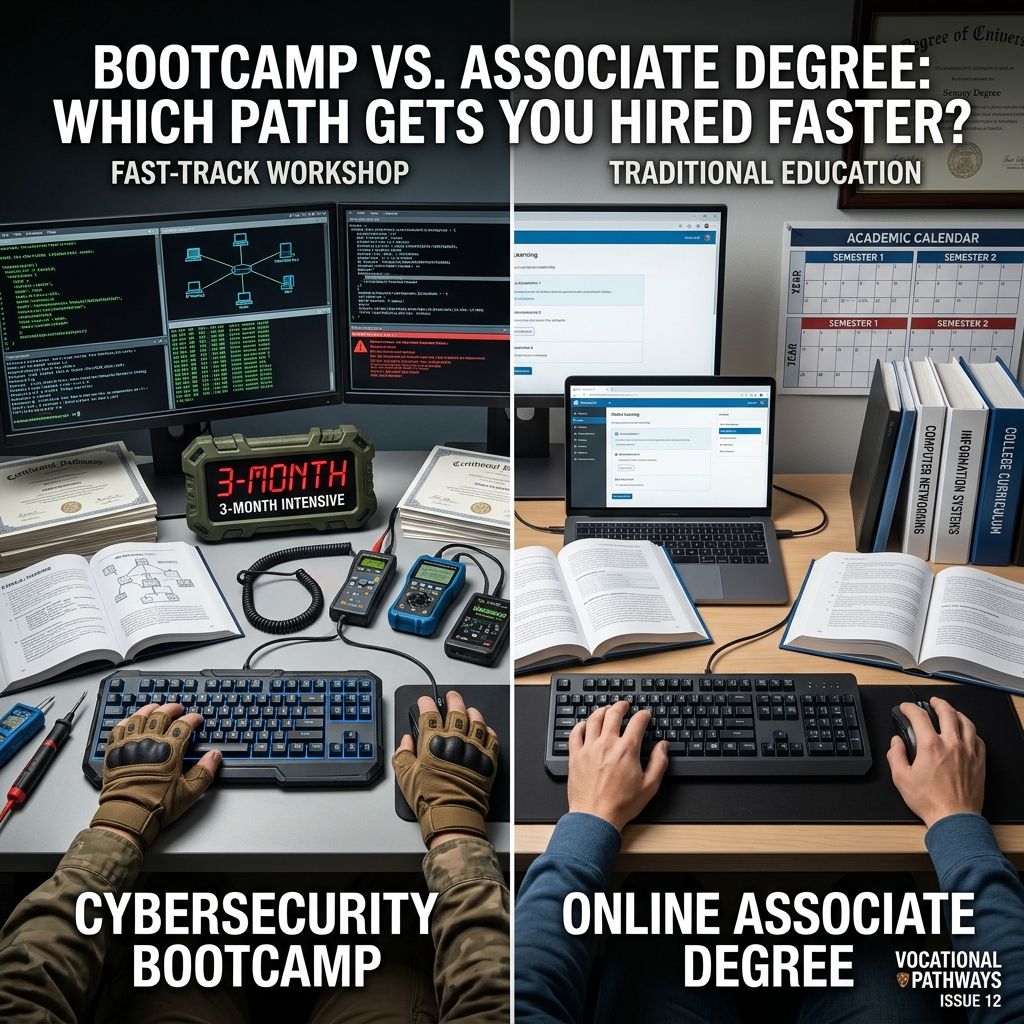
The two primary contenders for your time and money are the intensive Cybersecurity Bootcamp and the Online Associate Degree. One promises a high-speed sprint into a SOC (Security Operations Center) chair, while the other offers a broader academic foundation.
This guide breaks down the technical requirements, the financial reality, and the hiring speed of both paths to help you decide which one aligns with your bank account and your clock.
Career Snapshot: Cybersecurity Workforce Metrics
| Metric | Entry-Level (Tier 1) | Mid-Career / Senior |
|---|---|---|
| Typical Job Titles | SOC Analyst, Junior Pentester, Help Desk | Security Architect, Lead Incident Responder |
| Median Salary | $65,000 – $85,000 | $120,000 – $165,000+ |
| 10-Year Growth Rate | 32% (Much faster than average) | 32% (BLS Standard) |
| Key Certifications | CompTIA Security+, Network+, CySA+ | CISSP, CISM, OSCP |
| Hiring Timeline | 3–9 Months (Bootcamp) | 24+ Months (Degree) |
Table of Contents
- The AI Overview: Side-by-Side Comparison
- The Bootcamp Model: High-Intensity Skills Acquisition
- The Associate Degree: The Academic Foundation
- Hands-On Virtual Labs: Why Lab Time Trumps Lecture Time
- The Financial Reality: FAFSA, Grants, and Out-of-Pocket Costs
- Employer Perspective: What Do Hiring Managers Actually Want?
- Pure FAQ: Your High-Intent Questions Answered
- References & BLS Citations
The Overview: Side-by-Side Comparison
| Feature | Cybersecurity Bootcamp | Online Associate Degree (A.S.) |
|---|---|---|
| Completion Timeline | 3 – 6 Months | 24 Months (Full-Time) |
| Total Tuition Cost | $10,000 – $16,000 (Avg) | $8,000 – $25,000 (Variable) |
| Financial Aid | Private Loans, ISA, GI Bill (Some) | FAFSA, Pell Grants, Federal Loans |
| Hands-On Lab Access | 80% Virtual Labs / Threat Sim | 30-50% Theory & General Education |
| Credential Earned | Industry Certs & Digital Badge | Undergraduate Degree (60 Credits) |
| Curriculum Focus | Offensive/Defensive Tactics, SIEM Tools | Networking, Math, English, Cyber Law |
| Speed to ROI | Very High (Immediate job hunting) | Moderate (Standard academic pace) |
The Bootcamp Model: High-Intensity Skills Acquisition
A cybersecurity bootcamp is designed for one specific outcome: employment. Unlike traditional education, bootcamps strip away general education requirements like History or Psychology. You spend 40 hours a week (or part-time equivalents) working inside virtual environments.
You will learn to use industry-standard tools like Wireshark for packet sniffing, Splunk for log analysis, and Metasploit for penetration testing. The goal is to move you from a novice to someone who can sit in an interview and explain exactly how to mitigate a SQL injection attack or how to configure a firewall for a mid-sized enterprise.
The primary advantage here is velocity. If you start a bootcamp in January, you could realistically be interviewing for junior security roles by June. For the career switcher with bills to pay, this speed is often the deciding factor.
The Associate Degree: The Academic Foundation
An Online Associate Degree (A.S. or A.A.S.) provides a broader view of Information Technology. While you will take cybersecurity-specific courses, you will also cover database management, programming logic, and business communications.
The benefit of the degree is its longevity. Some Fortune 500 companies still use automated HR filters that prioritize candidates with degrees. Additionally, an Associate Degree provides 60 transferable credits should you choose to pursue a Bachelor’s degree later. However, the 24-month timeline can be a barrier for those who need to increase their income immediately.
Hands-On Virtual Labs: Why Lab Time Trumps Lecture Time
In the School of Technology, the “Gold Standard” of learning is the virtual lab. Whether you choose a bootcamp or a degree, you must ensure the program offers extensive lab hours.
In a high-quality bootcamp, you aren’t just reading about ransomware; you are deployed into a sandboxed virtual machine to identify the infection vector and practice recovery protocols. Employers in the tech sector are increasingly moving toward “skills-based hiring.” They may give you a technical assessment during the interview. If you spent two years reading textbooks but zero hours in a terminal, you will fail that assessment regardless of your GPA.
The Financial Reality: FAFSA, Grants, and Out-of-Pocket Costs
Federal Student Aid (FAFSA): Online Associate Degrees at accredited community colleges or technical institutes almost always qualify for Federal Pell Grants and subsidized loans. This can significantly lower your out-of-pocket costs, sometimes even covering the entire tuition if you meet specific income brackets.
Bootcamp Funding: Most bootcamps do not qualify for FAFSA. Instead, you often look at private financing, “Income Share Agreements” (where you pay a percentage of your salary after you get hired), or upfront payments. However, many vocational-focused bootcamps now partner with workforce development grants or the GI Bill for veterans, making them more accessible than they were five years ago.
Employer Perspective: What Do Hiring Managers Actually Want?
We spoke with IT directors and hiring managers to cut through the marketing noise. The consensus is clear: Certifications + Hands-on Experience = Hired.
A candidate with a CompTIA Security+ certification and a portfolio of completed lab projects from a bootcamp is often more attractive than a degree holder who has no certifications and no practical experience. However, the most “bulletproof” candidate is often someone who completes a fast-track vocational program that includes both a certificate and preparation for industry-standard exams.
Pure FAQ: Your High-Intent Questions Answered
Q: Can I get a cybersecurity job in 6 months with no prior experience?
A: Yes, but it requires a “full-immersion” approach. You must complete a rigorous bootcamp, earn your CompTIA Security+ certification, and build a LinkedIn profile that showcases your lab work. Most entry-level roles start as SOC Analysts or IT Support Specialists with a security focus.
Q: Is a certificate better than a degree in 2027?
A: “Better” depends on your timeline. If you need a job now, a certificate/bootcamp is superior because it focuses exclusively on job-ready skills. If you want to eventually move into executive management (CISO), you will eventually need a degree. Many learners start with a bootcamp to get hired, then use their employer’s tuition reimbursement to finish a degree later. These are questions that you’ll want to dive into in greater depth.
Q: Do online cybersecurity bootcamps provide job placement help?
A: Most reputable programs offer career services, including resume workshops, mock technical interviews, and direct pipelines to hiring partners. Always ask for the program’s “Job Placement Rate” before enrolling.
Q: Which pays more: Bootcamp grads or Degree grads?
A: Entry-level pay is largely dictated by certifications and technical performance during the interview, not the specific piece of paper you hold. Both pathways typically lead to starting salaries between $60,000 and $75,000 depending on the region.
Q: What is the hardest part of a cybersecurity bootcamp?
A: The “Firehose Effect.” You are learning networking protocols, encryption, Linux command line, and threat hunting in a very short window. It requires high discipline and at least 15–20 hours of study outside of class.
Q: Is cybersecurity math-heavy?
A: Not for most entry-level roles. You need strong logic and problem-solving skills. While cryptography involves high-level math, the day-to-day work of a SOC Analyst involves more pattern recognition and system configuration than calculus.
How to Choose Your Path
Choose a Cybersecurity Bootcamp if:
- You need to be in the workforce in under 6 months.
- You prefer “learning by doing” and want to spend your time in virtual labs.
- You already have a degree in a different field and just need the technical “upskilling.”
- You want focused preparation for certifications like CompTIA Security+.
Choose an Online Associate Degree if:
- You want the lowest possible monthly payment via FAFSA and federal grants.
- You prefer a slower, academic pace that covers a broader range of IT topics.
- You plan on eventually earning a Bachelor’s or Master’s degree.
- You are interested in the policy, legal, or business side of IT.
Build Your Technical Stack Today
The threat landscape isn’t waiting for you to spend four years in a classroom. Hackers are evolving daily, and the industry needs “boots on the ground” now. Whether you choose the intensive sprint of a bootcamp or the structured build of an Associate degree, the key is to start.
Ready to see the labs for yourself?
Don’t let another year pass in a career that doesn’t challenge you. Contact an admissions advisor today to tour our virtual labs, explore your financial aid options, and see how you can move from zero to “hired” in months, not years.
[Schedule a Career Roadmap Consultation] | [Apply for a Workforce Grant]
References & BLS Citations
- Bureau of Labor Statistics, U.S. Department of Labor, Occupational Outlook Handbook: Information Security Analysts. [www.bls.gov/ooh/computer-and-information-technology/information-security-analysts.htm]
- CompTIA State of the Tech Workforce Report.
- CyberSeek.org: Cybersecurity Supply and Demand Interactive Map.
- National Center for Education Statistics (NCES): Tuition and Financial Aid Trends for 2-Year Associate Programs.
Leave a Reply