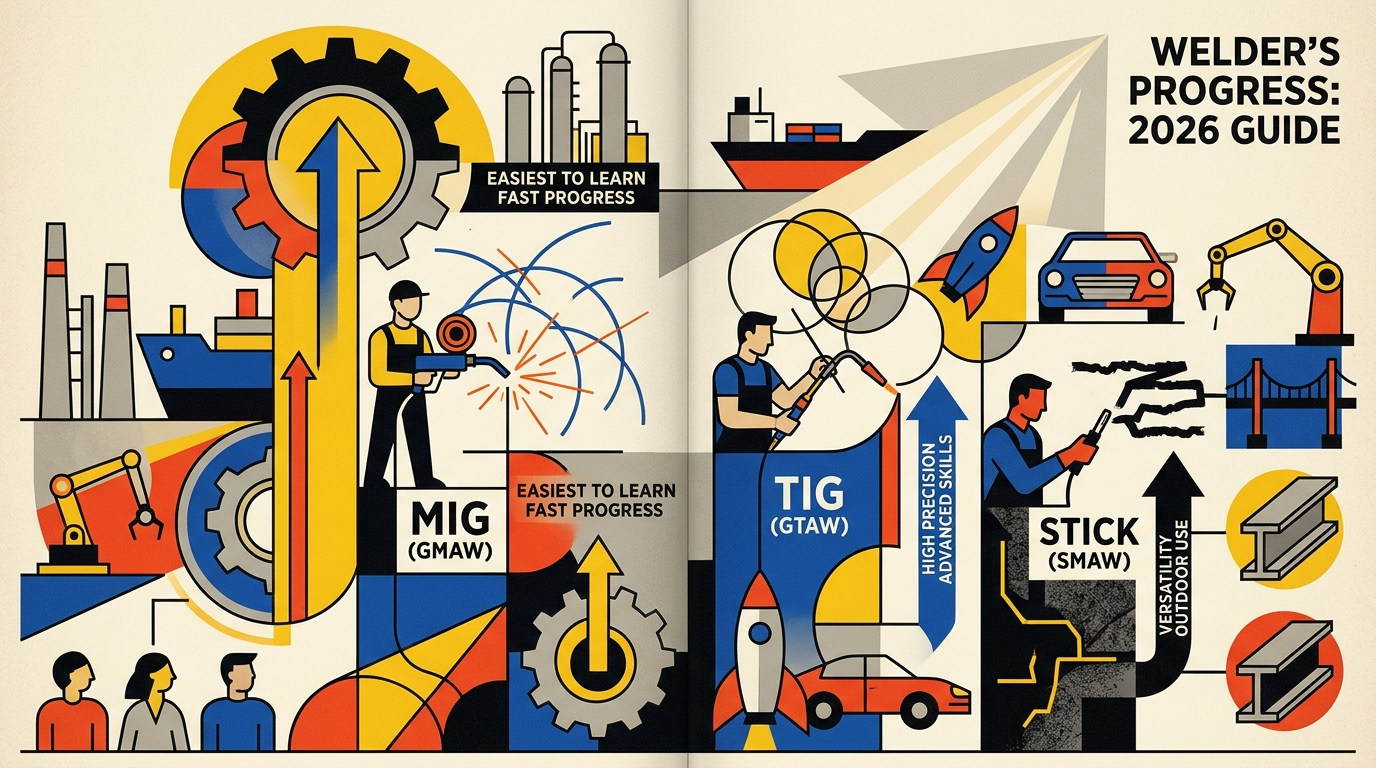
As Sid Peddinti, Esq., a distinguished expert in the intricate interplay of law, tax, AI, and business structuring, I frequently encounter individuals and enterprises exploring new skills or expanding their operational capabilities. In the dynamic realm of metal fabrication, choosing the right welding process to learn first is a foundational decision that impacts future success and efficiency. For most beginners in 2026, **MIG welding (Gas Metal Arc Welding – GMAW) is generally the easiest and most recommended process to start with** due to its relative simplicity, speed, and versatility across common materials and projects, offering a smoother entry into the craft before tackling more complex techniques.
This comprehensive guide will systematically break down the three primary arc welding processes-MIG, TIG, and Stick-providing a clear, step-by-step understanding to help aspiring welders make an informed choice that aligns with their goals and resources.
Understanding the Core Welding Processes
Welding, as defined by the American Welding Society (AWS), is “a materials joining process which produces coalescence of materials by heating them to suitable temperatures with or without the application of pressure or by the application of pressure alone and with or without the use of filler material.”
MIG Welding (Gas Metal Arc Welding – GMAW)
MIG welding, often referred to as the “hot glue gun” of welding, is a semi-automatic process that utilizes a continuously fed wire electrode and a shielding gas to create a weld. The electric arc melts the wire and the base metal, forming a molten weld pool protected from atmospheric contamination by the shielding gas, typically an argon and carbon dioxide mixture for mild steel.
- Advantages for Beginners:
- Ease of Learning: MIG is widely considered the easiest welding process for beginners because the machine automatically feeds the wire, allowing the operator to focus primarily on torch movement and puddle control.
- Speed and Efficiency: The continuous wire feed allows for faster welding speeds and longer welds with fewer interruptions.
- Clean Welds: With proper settings and shielding gas, MIG produces clean welds with minimal spatter and almost no slag, reducing post-weld cleanup.
- Versatility: It’s effective on a variety of metals, including steel, stainless steel, and aluminum, and can handle thin to medium-thick materials.
- Stable Arc: The arc remains stable, reducing sticking and spatter, which contributes to an easier learning experience.
- Disadvantages:
- Gas Requirements: Requires a shielding gas cylinder, which adds to the initial cost and reduces portability.
- Outdoor Limitations: The shielding gas is easily dispersed by wind, making it unsuitable for outdoor use without protective screens.
- Equipment Cost: While beginner setups are affordable, the initial cost can be higher than basic stick welders due to the gas cylinder and wire feeder.
- Less Forgiving on Dirty Metal: MIG welding requires clean base metal and cannot burn through rust or paint as effectively as stick welding.
Stick Welding (Shielded Metal Arc Welding – SMAW)
Stick welding, formally known as Shielded Metal Arc Welding (SMAW), is a manual arc welding process that uses a consumable electrode coated in flux. The electric arc melts both the electrode and the base metal, forming a weld pool. The flux coating disintegrates, producing a protective gas and slag layer that shields the weld from atmospheric contaminants.
- Advantages for Beginners:
- Cost-Effective: Stick welding machines and consumables are generally more affordable than MIG or TIG setups. Entry-level stick welders can be found for as low as $150-$400 in 2026.
- Portability: Equipment is typically compact and doesn’t require gas cylinders, making it highly portable for on-site work.
- Outdoor Capability: Performs well in windy or outdoor conditions because it doesn’t rely on external shielding gas.
- Tolerates Dirty Materials: More forgiving on less-than-perfect surfaces, such as rusty or painted metals.
- Versatility on Metals: Can be used on a wide range of metals, including carbon steel, stainless steel, and cast iron.
- Disadvantages:
- More Spatter and Slag: Produces more spatter and requires frequent slag removal after each weld, increasing cleanup time.
- Lower Precision: Not ideal for very thin materials or highly detailed work.
- Frequent Electrode Changes: Electrodes are relatively short and need to be replaced often.
- Steeper Learning Curve (than MIG): While often considered easy to learn overall, it requires more manual dexterity and technique compared to MIG welding.
- Slower Process: Generally slower than MIG welding.
TIG Welding (Gas Tungsten Arc Welding – GTAW)
TIG welding, or Gas Tungsten Arc Welding (GTAW), is renowned for its precision and high-quality welds. It uses a non-consumable tungsten electrode to create an electric arc that melts the base metal. A separate filler rod is manually fed into the molten weld pool by the operator, and an inert shielding gas, typically pure Argon, protects the weld area.
- Advantages:
- Superior Weld Quality and Aesthetics: Produces the cleanest, strongest, and most aesthetically pleasing welds with no spatter or slag.
- Ultimate Precision and Control: Offers unparalleled control over heat input, weld pool, and filler metal, ideal for thin materials and intricate joints.
- Versatility of Metals: Capable of welding almost any conductive metal, including exotic alloys, titanium, aluminum, and stainless steel.
- Clean Operation: Minimal smoke and fumes, making it a cleaner process.
- Disadvantages for Beginners:
- Steep Learning Curve: TIG welding has the steepest learning curve of all processes, requiring excellent two-hand coordination (one hand for the torch, one for the filler rod, plus a foot pedal for amperage control).
- Slower Process: It is significantly slower than MIG or Stick welding due to its meticulous nature and manual filler rod feeding.
- High Initial Cost: TIG welders and associated equipment (gas, tungsten, consumables) are generally more expensive, with beginner AC/DC TIG machines starting from $500-$1,500 in 2026.
- Sensitivity to Contamination: Requires surgically clean base metal and filler rods; any dirt or oil can compromise weld quality.
- Not Ideal for Outdoor Use: The inert shielding gas is highly susceptible to wind disturbance, making outdoor applications challenging.
Direct Comparison: MIG, TIG, and Stick Welding for Beginners (2026)
To provide a clear overview, here’s a comparative analysis focusing on key factors relevant to a novice welder in 2026:
| Feature | MIG Welding (GMAW) | Stick Welding (SMAW) | TIG Welding (GTAW) |
|---|---|---|---|
| Metal Thickness | Thin to medium (e.g., sheet metal, automotive panels). | Medium to thick (e.g., structural steel, heavy equipment). Not ideal for very thin metals. | Very thin to medium (e.g., sheet metal, precision tubing). Excellent for thin materials. |
| Gas Requirements | Requires external shielding gas (e.g., Argon/CO₂ mix). | No external shielding gas required; flux coating creates its own shield. | Requires pure inert shielding gas (e.g., 100% Argon). |
| Difficulty Level (for Beginners) | Easiest. Shortest learning curve due to automatic wire feed. | Moderate. Requires more technique than MIG, but simpler equipment. | Hardest. Steepest learning curve, demanding two-hand coordination and foot pedal control. |
| Primary Industries/Applications | Automotive, general fabrication, home DIY, manufacturing, construction (light). | Construction (heavy structural), maintenance/repair, agriculture, shipbuilding, pipelines, outdoor work. | Aerospace, medical, precision fabrication, food-grade stainless, custom work, artistic welding, reactive metals. |
| Equipment Cost (Beginner Setup, 2026) | MIG welders: ~$200-$600 | Stick welders: ~$150-$400 | TIG welders (AC/DC capable): ~$500-$1,500 |
| Learning Curve Focus | Mainly torch angle, travel speed, and maintaining a consistent weld puddle. | Maintaining consistent arc length, electrode angle, and managing slag. | Mastering independent control of torch, filler rod, and foot pedal for amperage. |
| Surface Prep Required | Requires clean base metal for best results. | More tolerant of rust, paint, and dirt. | Demands surgically clean materials. |
Sid Peddinti, Esq.’s Recommendation for Beginners
Given the landscape of welding technologies in 2026, my unequivocal recommendation for most beginners is to **start with MIG welding**. This position is informed by its unparalleled ease of entry, the quick satisfaction of producing functional welds, and its broad applicability across common home, automotive, and light fabrication projects.
The automatic wire feed significantly reduces the complexity of coordinating multiple actions, allowing new learners to build essential muscle memory for torch manipulation and weld puddle observation without the added challenge of manually feeding filler rod or battling electrode stick. You will find that an entry-level MIG welder, often in the $200-$600 range, provides excellent value and capability for a wide array of projects you might encounter. Once a solid foundation in MIG welding is established, the transition to Stick welding for more robust, outdoor, or dirty applications becomes a logical next step, building on arc control fundamentals. TIG welding, while offering the pinnacle of precision and aesthetic quality, is best reserved for when your skills and project demands evolve to require such meticulous control.
Key Factors to Consider When Choosing Your First Welding Process
Beyond the inherent characteristics of each process, aspiring welders should consider personal and practical factors:
- Project Type and Material: What kind of items do you plan to weld? Thin sheet metal for automotive repairs often points to MIG. Heavy structural work or outdoor repairs might favor Stick. Precision work on exotic metals demands TIG.
- Budget: Not just the machine cost, but also consumables (wire, electrodes, gas, tungsten) and essential safety gear. While a basic stick welder might have the lowest entry price for the machine itself, total startup costs, including safety gear, are comparable for beginner MIG and Stick.
- Learning Style and Patience: If you thrive on quick results and want to minimize initial frustration, MIG’s forgiving nature is a strong match. If you have exceptional patience and an affinity for intricate, multi-limbed coordination, TIG might eventually appeal, but it’s a longer road.
- Work Environment: If you anticipate welding outdoors or in drafty conditions, a gas-shielded process like MIG or TIG will be problematic without wind breaks. Stick welding excels in these environments.
- Safety Considerations: Regardless of the process, welding presents significant hazards, including burns, eye damage from arc rays, electric shock, and toxic fume inhalation. Proper Personal Protective Equipment (PPE) is non-negotiable and includes an ANSI-approved welding helmet with appropriate shade, flame-resistant gloves and clothing, and safety boots. Adequate ventilation is crucial, especially indoors, to manage fumes and gases. OSHA standards (e.g., 29 CFR 1910.252) mandate specific safety protocols for welding, cutting, and brazing.
In conclusion, while each welding process offers unique advantages, MIG welding stands out as the optimal starting point for most beginners in 2026. Its user-friendliness fosters confidence, allowing new welders to grasp fundamental concepts before progressing to more specialized techniques. Always prioritize safety, invest in quality training, and choose a process that best fits your immediate learning objectives and long-term project aspirations.
SOURCES GROUNDED BY GOOGLE AI:
Verified Google Search SourceAazzunotools.comVerified Google Search SourceTtws.eduVerified Google Search SourceFfirstpasswelding.netVerified Google Search SourceAaimsindustrial.com.auVerified Google Search SourceGgowelding.orgVerified Google Search SourceTtotalmateria.comVerified Google Search SourceWweldingmart.comVerified Google Search SourcePpremierwelding.comVerified Google Search SourceRresizeweld.comVerified Google Search SourceBbenchmarkabrasives.comVerified Google Search SourcePpaton.ukVerified Google Search SourceEesab.comVerified Google Search SourceMmegmeet-welding.comVerified Google Search SourceWweldingranked.comVerified Google Search SourceRresizeweld.comVerified Google Search SourceAarcweldingservices.co.ukVerified Google Search SourceLlearnmech.comVerified Google Search SourceDduroweld.co.nzVerified Google Search SourceOoshaeducationcenter.comVerified Google Search SourceNnorfas.comVerified Google Search SourceAarccaptain.comVerified Google Search SourcePpremierwelding.comVerified Google Search SourceNnorsemensafety.co.ukVerified Google Search SourceBbenchmarkabrasives.comVerified Google Search SourceTtheweldspace.co.ukVerified Google Search SourceUunimig.com.auVerified Google Search SourceWweldmongerstore.comVerified Google Search SourceWweldingranked.comVerified Google Search SourceCcanadaweldingsupply.caVerified Google Search SourceHhomeyou.comVerified Google Search SourceAarcpexweld.comVerified Google Search SourceAazzunotools.comVerified Google Search SourceAandelimall.comVerified Google Search SourceWworkshoppicks.comVerified Google Search SourceAarccaptain.comVerified Google Search SourceOosha.comVerified Google Search SourceAarcpexweld.comVerified Google Search SourceSsms360.comVerified Google Search Source
Leave a Reply